“We spurred each other on,” feminist psychoanalytic scholar Jacqueline Rose noted of her relationship with sister Gillian Rose, sociologist and philosopher, in a recent interview with The New Yorker. “I hope I said ‘spurred.’ If I said ‘spurned,’ that’s also quite interesting. I think both are true.” While the two remained largely private about their relationship over the years, statements such as this point to a mutual interest in and attraction to one another’s intellectual and personal lives. Raised in London in a family with the surname “Stone,” both sisters chose to take their stepfather’s “Rose” in an act of emancipation from their father. In her philosophical memoir Love’s Work, Gillian Rose writes of this name change at age sixteen, noting: “The Name: the Name. A rose is [not] a rose is [not] a rose is [not] a rose. And it was Gertrude Stein who formulated the positive version of that liturgy – Stein, a ‘Stone,’ no less.”
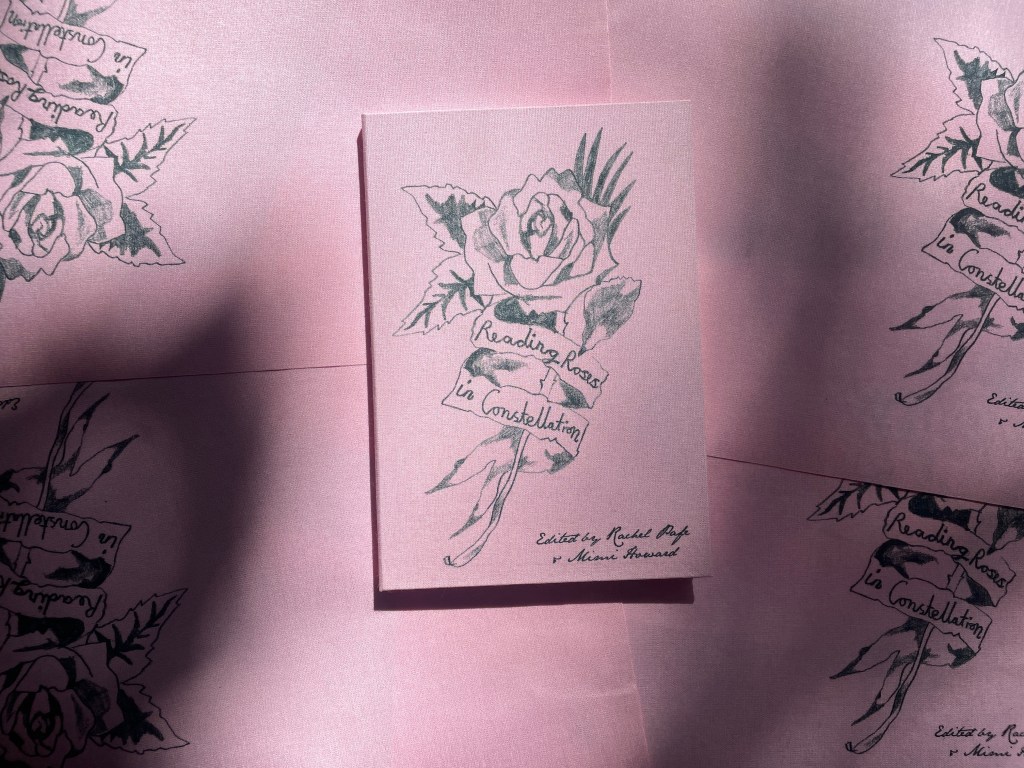
The seemingly contradictory images of roses and stones seem plucked from the annals of romance novels replete with petal-covered beds, swords magically pulled out of stony outcrops. In the Reading Roses in Constellation (RRIC) reading group and publication project, we were interested in playing with a fraught notion of desire that is at once soft and stony, spurring and spurning. We focused on the intertwined output and constellatory implications of the two prolific Rose sisters, asking how their work explores desire as a horizontal projection rather than one involving simplistic hierarchies. Traditionally, desire is represented as a vertical exchange based on the authority of the parent to child, analyst to patient, or unrequited crush to admirer. RRIC was interested in examining desire as flowing across and flooding such boundaries.
RRIC originally took place in two sessions of reading groups at Hopscotch Reading Room in Berlin. Four meetings in May 2024 were devoted to Jacqueline and four meetings in July 2024 devoted to Gillian, both Roses constantly on the brain. In readings focusing on mothers, sisters, lovers, partners, limerence crushes, and friendships, we unpacked how the de-hierarchization of particular understandings of desire can critique power structures that make them seem fixed and natural. The Jacqueline readings featured guest sessions from psychoanalysis scholar Myriam Sauer and poet Seda Mimaroğlu, writings from Rose’s friend Edward Said, and fiction about childhood in Palestine from writer Adania Shibli. The Gillian readings focused on deep dives into her Love’s Work, Hegel Contra Sociology, Mourning Becomes the Law, and The Broken Middle, featuring a guest session focusing on “gay Roses” with writer and researcher Sam Dolbear.
Co-edited by Mimi Howard and Rachel Pafe and published by Pseudo Press (Berlin 2025). Original design by Danae Io, cover art by Charlotte Murdoch.

 Rachel Pafe